
Voice Handicap Index (VHI) Scoring: A Clinician’s Guide to VHI-30, VHI-10, and Severity Bands
What the research actually says about scoring, severity bands, and the minimal clinically important difference — and where self-report and acoustic data disagree.
Try Free Demo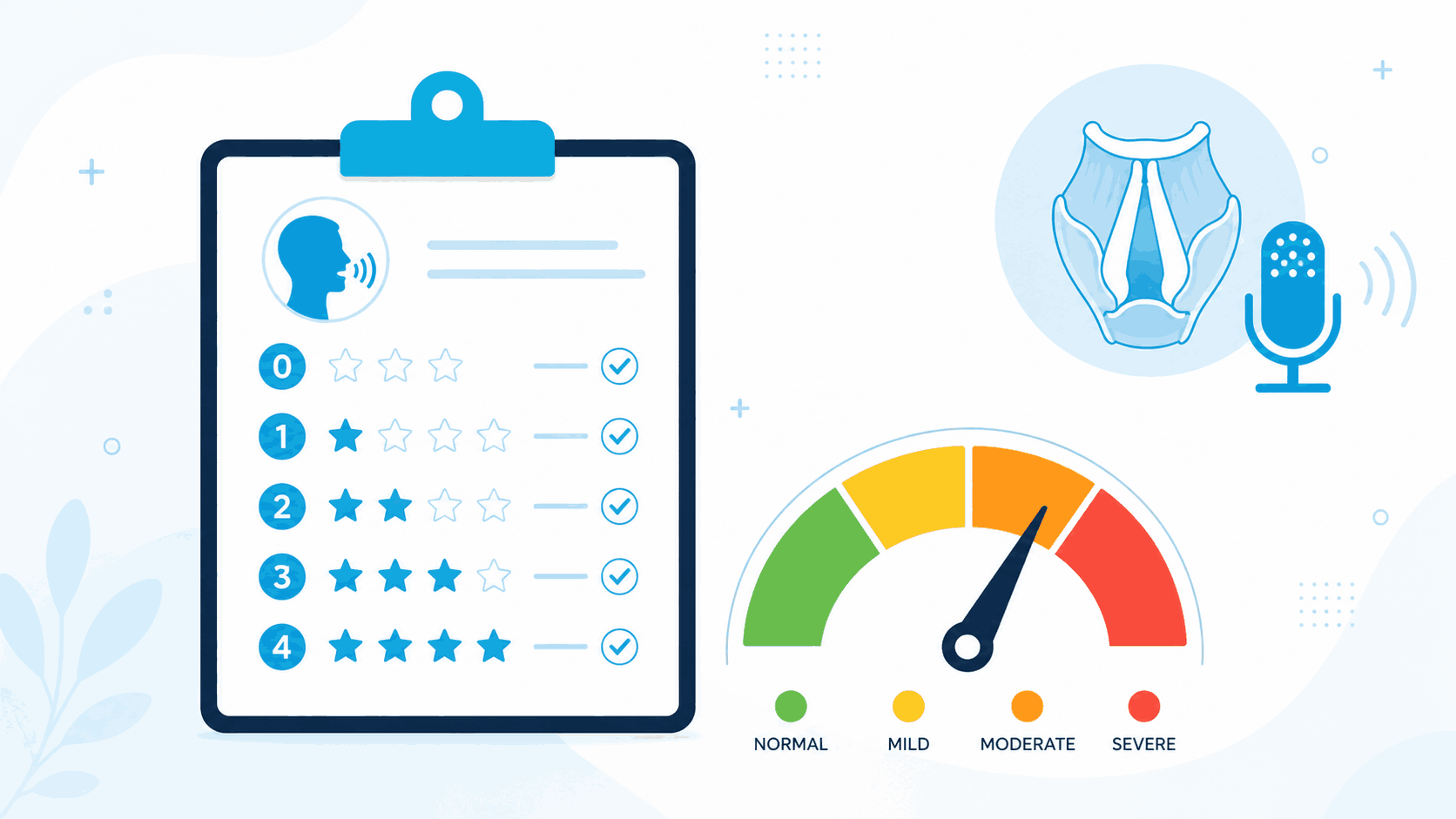
Acoustic metrics like CPP, shimmer, and HNR tell you how a voice performs. They don’t tell you how a voice feels to the person using it. That’s the gap the Voice Handicap Index (VHI) was built to close — a patient-reported outcome measure that turns a subjective burden into a number a clinician can track over time.
The VHI is one of the most cited instruments in voice-language pathology, but most summaries of it stop at “30 items, three domains, higher is worse.” This guide goes a level deeper: what the original validation actually found, why the 10-item short form largely replaced it in practice, what a “clinically meaningful” score change really means according to the outcome literature, and where VHI scores and objective acoustic data disagree — and why that disagreement is itself clinically useful information.
What the VHI actually measures
Before 1997, there was no standardized way to quantify the psychosocial impact of a voice disorder — clinicians relied on informal impressions. Jacobson and colleagues addressed this by administering an 85-item pilot questionnaire to 65 consecutive patients at the Henry Ford Hospital Voice Clinic, then using internal-consistency analysis to reduce it to a final 30-item instrument with strong test-retest stability.
The final 85-item version was reduced to 30 items across three subscales, each capturing a distinct dimension of how a voice problem affects daily life. Jacobson et al., 1997, American Journal of Speech-Language Pathology
Each of the 30 items is rated 0 (never) to 4 (always), for a maximum total score of 120. Higher scores mean a greater self-perceived handicap.
VHI-30 vs. VHI-10 vs. the population-specific variants
Because a 30-item form is slow to administer at every visit, Rosen and colleagues used item analysis across 819 patients and 159 controls to build a 10-item short form. The VHI-10 correlates with the full VHI at r > 0.90 and is now the version most US voice clinics use for routine intake and progress tracking.
| Instrument | Best for | Items / Range | Source |
|---|---|---|---|
| VHI-30 | Initial full clinical work-up, research protocols needing domain-level detail | 30 items, 0–120 | Jacobson et al., 1997 |
| VHI-10 | Routine intake, session-to-session progress tracking | 10 items, 0–40 | Rosen et al., 2004 |
| pVHI | Pediatric dysphonia, completed by a parent/caregiver proxy | 23 items, parent-report | Zur et al., 2007 |
| SVHI-10 | Singers and professional voice users; captures singing-specific demands the standard VHI misses | 10 items, abnormal ≥20 | Cohen et al. / Perrin et al., 2025 (MCID) |
Severity bands: turning a raw score into a clinical category
Arffa, Krishna, Gartner-Schmidt, and Rosen (2012) established the four-band classification most US voice clinics now use to translate the VHI-10 total into a category, based on normative data from patients and controls.
| Score range | Band | Clinical read |
|---|---|---|
| 0–10 | Normal | No perceived voice handicap |
| 11–20 | Mild | Noticeable but limited functional impact |
| 21–30 | Moderate | Meaningful daily-life restriction |
| 31–40 | Severe | Substantial functional and emotional burden |
A caveat worth flagging to trainees: a study of a treatment-seeking dysphonia population found that a meaningful proportion of patients actively pursuing care still scored below the abnormal cutoff of 11 — a reminder that the VHI-10 is one input into the clinical picture, not a gatekeeper for who deserves treatment.

How big a score change actually means something?
A lower post-treatment VHI-10 score feels like progress. But “lower” isn’t automatically “clinically meaningful” — test-retest variability alone can move a score by a few points. This is where the minimal clinically important difference (MCID) matters, and where the literature doesn’t fully agree.
The gap between 4 and 6 points isn’t noise — it reflects that MCID is population-specific. A vocal fold paralysis cohort recovering from a discrete surgical event moves differently than a mixed general voice-clinic population. Applying a single flat “5-point rule” to every diagnosis, as many clinicians were trained to do, risks both false positives and false negatives on treatment response.
A difference of 6 on the VHI-10 was associated with a moderate change on the global rating scale, while smaller changes could not reliably be distinguished from no change at all. Misono, Yueh, Stockness, House & Marmor, 2017, JAMA Otolaryngology–Head & Neck Surgery
Why VHI scores and acoustic measures don’t always agree — and why that’s useful
It’s tempting to assume a patient’s self-reported handicap should track closely with objective acoustic findings. The research says otherwise. Gillespie, Gooding, Rosen, and Gartner-Schmidt (2014) compared VHI-10 change against voice laboratory measures across five common voice disorders and found the relationship was inconsistent across diagnoses — acoustic measures sometimes stayed flat while VHI-10 moved, and vice versa.
This cuts both ways clinically. Professional voice users — teachers, singers, broadcasters — are trained to compensate, and can post a normal VHI-10 (<10) while still showing significant pathology on laryngoscopy. Conversely, a patient can report high handicap with relatively mild acoustic deviation, particularly when the emotional and functional domains are driving the score rather than the physical one.
Pairing self-report with objective metrics like F0 and CPP — rather than treating either as sufficient alone — is what closes that gap. This is the rationale behind reading PRAAT acoustic output alongside patient-reported outcomes during a full voice evaluation.
Beyond the standard adult VHI
The original VHI was normed on an adult clinical population, which limits its fit for children and for the specific demands of singing. Two variants address that gap.
Frequently asked questions
Sources cited
- Jacobson, B. H. et al. (1997). The Voice Handicap Index (VHI): Development and Validation. American Journal of Speech-Language Pathology, 6(3), 66–70. pubs.asha.org
- Rosen, C. A., Lee, A. S., Osborne, J., Zullo, T., & Murry, T. (2004). Development and validation of the Voice Handicap Index-10. The Laryngoscope, 114(9), 1549–1556. onlinelibrary.wiley.com
- Arffa, R. E., Krishna, P., Gartner-Schmidt, J., & Rosen, C. A. (2012). Normative values for the Voice Handicap Index-10. Journal of Voice, 26(4), 462–465. sciencedirect.com
- Young, V. N. et al. (2018). Minimal clinically important difference of Voice Handicap Index-10 in vocal fold paralysis. The Laryngoscope, 128(6), 1419–1424. pubmed.ncbi.nlm.nih.gov
- Misono, S., Yueh, B., Stockness, A. N., House, M. E., & Marmor, S. (2017). Minimal Important Difference in Voice Handicap Index–10. JAMA Otolaryngology–Head & Neck Surgery. pmc.ncbi.nlm.nih.gov
- Gillespie, A. I., Gooding, W., Rosen, C., & Gartner-Schmidt, J. (2014). Correlation of VHI-10 to voice laboratory measurements across five common voice disorders. Journal of Voice, 28(4), 440–448. pubmed.ncbi.nlm.nih.gov
- VHI-10 Scores in a Treatment-Seeking Population With Dysphonia. ScienceDirect. sciencedirect.com
- Perrin, D. et al. (2025). Singing Voice Handicap Index-10 Minimal Clinically Important Difference: A Prospective Determination. The Laryngoscope, 135, 752–757. pubmed.ncbi.nlm.nih.gov
Pair self-report with objective acoustic data
Phonalyze runs PRAAT-grade acoustic analysis alongside your patient-reported outcomes, so VHI scores and objective voice metrics live in the same record.
Try Free Demo Learn More →