Cloud-Based Speech Therapy: How Phonalyze is Transforming Remote Voice Assessment
Voice disorders affect an estimated 7.5 million Americans annually, yet specialist access remains concentrated in urban centers. Cloud technology is closing that gap — and for SLPs, the shift to platforms like Phonalyze is not just a matter of convenience, it is a clinical imperative.
From Clinic to Cloud: The Evolution of Speech Therapy
Traditional speech therapy relied entirely on in-person contact. Clinicians and patients met face-to-face for assessment, treatment, and follow-up — a model that worked in urban centers but left rural communities and patients with mobility challenges chronically underserved.
The COVID-19 pandemic accelerated the digital shift dramatically. According to the Centers for Disease Control and Prevention, telehealth utilization increased by 154% in early 2020. For speech-language pathologists, this forced a reckoning — the traditional model needed a cloud-native alternative.
The American Speech-Language-Hearing Association (ASHA) now recognizes telepractice as an appropriate service delivery model for speech-language pathology across the lifespan. Platforms like Phonalyze provide the clinical infrastructure to make that recognition operational.
What Is Cloud-Based Speech Therapy?
Cloud-based speech therapy refers to the delivery of SLP services — assessment, treatment, and progress monitoring — through internet-connected platforms, without requiring in-person clinic attendance. The cloud handles data capture, storage, processing, and reporting entirely remotely.
How Phonalyze Uses Cloud Technology
Phonalyze, developed by Cognizn, is a cloud-native SaaS platform purpose-built for speech-language pathologists and laryngologists. Unlike general video conferencing tools repurposed for telehealth, Phonalyze integrates PRAAT-validated AI algorithms, HIPAA-compliant data infrastructure, and an SMS patient workflow into a single seamless system.
Voice Data in the Cloud: Step-by-Step Workflow
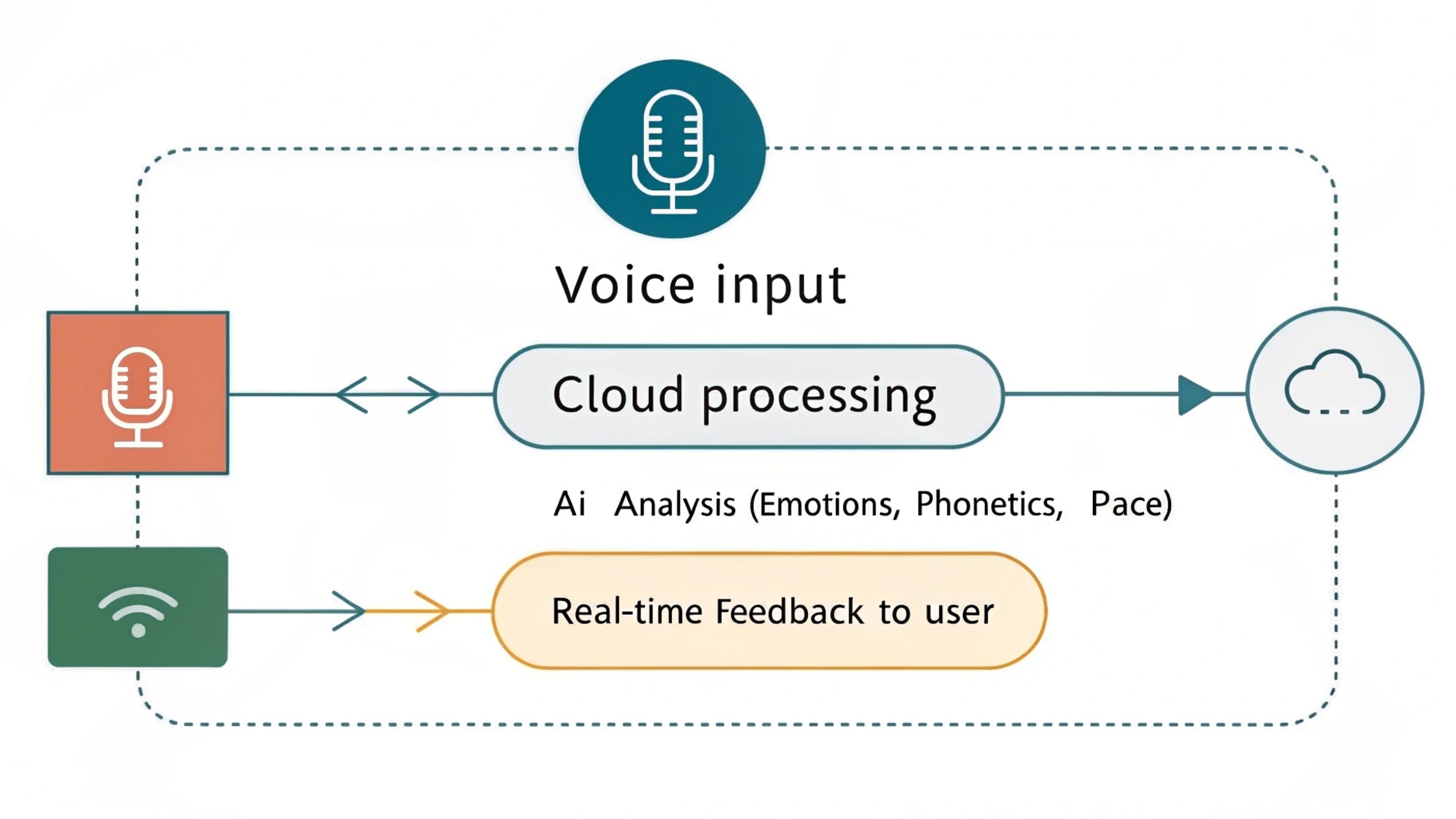
Understanding how voice data moves through Phonalyze’s cloud infrastructure helps clinicians explain the process to patients and integrate it confidently into their practice workflow.
-
1Clinician creates patient sessionThe SLP logs into Phonalyze via any browser, creates a patient session, and selects appropriate voice tasks — sustained vowels, CAPE-V sentences, conversational speech, or pitch glides.
-
2Secure SMS link sent to patientThe patient receives a unique secure recording URL via SMS from a Phonalyze number. The clinician’s personal phone number is never exposed. The link opens in the patient’s browser — no app download required.
-
3Patient completes voice recording at homeThe patient records their voice tasks at a time that suits them. The browser interface guides them through each task with clear on-screen instructions. No technical knowledge required.
-
4Audio uploaded to HIPAA-compliant cloudThe recording is securely transmitted to Phonalyze’s HIPAA-compliant cloud infrastructure via end-to-end encrypted channels. No voice data is stored locally on the patient’s device.
-
5PRAAT-validated AI analysis runs in the cloudPhonalyze’s cloud-side AI engine extracts acoustic features — fundamental frequency (F0), jitter, shimmer, harmonics-to-noise ratio (HNR), and voice break locations — using PRAAT-validated algorithms and machine learning pattern recognition. Learn more in our HNR clinical guide.
-
6Clinician receives instant structured reportWithin minutes of task completion, the SLP receives an email notification and accesses the full report online — including per-task acoustic metrics, spectrograms, and session summaries ready for clinical documentation.
Key Benefits of Cloud-Based Speech Therapy for SLPs and Patients
Eliminating geographic barriers
Cloud platforms are most transformative for patients in rural or underserved areas where specialist access is limited. Many counties in the United States have no speech-language pathologist within a reasonable driving distance. Phonalyze enables these patients to receive clinical-grade acoustic voice assessment without leaving home — connecting them with SLPs anywhere in the country.
Flexible scheduling and reduced no-show rates
Because patients complete voice tasks asynchronously via the SMS link — at their own pace — scheduling conflicts and travel time are eliminated. Asynchronous remote care models consistently show reduced patient no-show rates compared to in-person appointments, improving clinical efficiency and therapy continuity.
Objective, reproducible acoustic data
Unlike perceptual assessment alone, cloud-based acoustic analysis provides consistent, reproducible measurements not subject to listener variability. Phonalyze’s PRAAT-validated metrics — jitter, shimmer, HNR, and fundamental frequency — provide the same objective data whether the patient records from Boston or rural Montana. For a deep dive into these metrics, see our clinical guide to voice disorders.
Cost-effectiveness and scalability
At $39/month for an individual plan — approximately $1/day — Phonalyze is accessible to solo practitioners and large group practices alike. No specialist hardware to purchase. No software to license per device. No per-analysis fee. The platform scales as your caseload grows.
Phonalyze vs. Traditional Speech Therapy Delivery
| Feature | Phonalyze (cloud) | Video call only | In-clinic session |
|---|---|---|---|
| Acoustic voice analysis | ✓ Automated AI | ✗ Not available | Manual / equipment |
| HIPAA compliance | ✓ Certified | Varies by platform | ✓ Via facility |
| Patient records from home | ✓ SMS link | Synchronous only | ✗ In-person required |
| Jitter, shimmer, HNR metrics | ✓ Instant | ✗ No | Specialist equipment |
| Automated clinical report | ✓ Minutes | ✗ No | Manual documentation |
| Longitudinal progress tracking | ✓ Built-in | Manual comparison | Manual comparison |
| Software installation | ✓ None required | App required | Specialist hardware |
| Cost | From $39/month | Platform fees vary | High (facility + staff) |
AI and Machine Learning in Cloud Speech Therapy
The integration of artificial intelligence with cloud infrastructure represents the most significant advancement in speech therapy delivery in decades. AI enables cloud platforms to do what video conferencing alone cannot: objectively analyze the acoustic properties of a patient’s voice and return clinically actionable data.
Phonalyze’s cloud-side AI engine uses machine learning models trained on clinical voice datasets to detect patterns associated with specific voice pathologies. A 2023 study in the Journal of Voice found that AI models achieved over 90% accuracy in detecting vocal nodules from acoustic data alone — comparable to experienced laryngologists. This level of diagnostic support, delivered remotely and instantly, was impossible before cloud AI.
For a deeper exploration of AI in voice disorder diagnosis, read our guide: AI-Powered Voice Disorder Diagnosis: How Phonalyze is Transforming Speech Pathology.
HIPAA Security and Data Privacy in the Cloud
Data privacy is non-negotiable in clinical practice. The HHS Office for Civil Rights requires all telehealth and cloud-based health platforms to meet HIPAA Technical Safeguards for electronic Protected Health Information (ePHI). Phonalyze is built to these standards from the ground up:
Real-World Use Cases with Phonalyze
Future Trends: VR, AR, and Predictive Analytics
Predictive analytics for proactive vocal health
As longitudinal acoustic datasets grow, machine learning models will increasingly predict vocal health deterioration before it becomes clinically significant — alerting SLPs to patients at risk based on subtle trends in jitter, shimmer, and HNR. Phonalyze’s longitudinal tracking infrastructure is designed to support this next generation of predictive capability.
Virtual and augmented reality in speech therapy
Immersive technologies including VR and AR are beginning to enter speech therapy — offering interactive, gamified environments for voice exercises and articulation practice. As these technologies mature and become cloud-deliverable, they will integrate naturally with platforms like Phonalyze’s acoustic assessment layer.
Expanding global access to specialist care
The World Health Organization estimates over 2.5 billion people worldwide need rehabilitation services — including speech therapy — but fewer than half can access them. Cloud-based platforms represent the most scalable path to closing this gap, particularly in low- and middle-income countries where specialist density is lowest.
Plans & Pricing
Phonalyze offers flexible cloud plans for individual SLPs and group practices. The free trial gives full Individual plan access — no credit card required.
- 1 clinician account
- Unlimited patient sessions
- Full acoustic metrics
- SMS patient links
- Session reporting
- No credit card required
- 1 clinician account
- Unlimited patient sessions
- Full acoustic metrics
- SMS patient links
- Session reporting
- HIPAA-compliant cloud storage
- Multiple therapist accounts
- Shared patient population
- Multi-therapist access controls
- Collaborative assessment tools
- Priority support
Frequently Asked Questions
Cloud-based speech therapy refers to the delivery of SLP services — assessment, treatment, and progress monitoring — through internet-connected platforms without requiring in-person clinic visits. Platforms like Phonalyze enable SLPs to conduct acoustic voice assessments, assign patient tasks, and track outcomes remotely via HIPAA-compliant cloud infrastructure. ASHA recognizes telepractice as an appropriate service delivery model for speech-language pathology.
Yes — when using a certified platform. Phonalyze is built on HIPAA-compliant infrastructure with end-to-end encryption, anonymous URL generation, and protected patient data transmission. The HHS Office for Civil Rights requires all cloud-based health platforms to meet HIPAA Technical Safeguards for ePHI — Phonalyze meets these requirements by design.
Phonalyze uses cloud infrastructure to capture, transmit, process, and report acoustic voice data remotely. The patient records via a secure browser link (no app required), audio is encrypted and sent to Phonalyze’s HIPAA-compliant cloud, PRAAT-validated AI algorithms analyze the recording for pitch, jitter, shimmer, HNR, and voice breaks, and the SLP receives a full clinical report within minutes.
Cloud-based tools complement, not replace, in-person speech therapy. For acoustic assessment, remote monitoring, and progress tracking, Phonalyze delivers results equivalent to clinic-based tools. However, procedures requiring physical examination — such as laryngoscopy — still require in-person visits. The optimal model combines cloud-based assessment with periodic in-person consultations when clinically necessary.
Key benefits include:
- Elimination of geographic barriers — rural patients access specialist care
- Flexible asynchronous scheduling — no travel required
- Objective, reproducible acoustic data — not subject to listener variability
- Longitudinal progress tracking across sessions
- Reduced cost vs. clinic-based tools — from $39/month
- HIPAA-compliant secure data management with automated reporting
AI improves cloud-based speech therapy by automating acoustic analysis, detecting voice disorder patterns with clinical-grade accuracy, and personalizing therapy recommendations based on patient data. A 2023 study in the Journal of Voice found AI models achieved over 90% accuracy detecting vocal nodules from acoustic data alone. Phonalyze delivers this AI analysis remotely via the cloud. Read more in our AI speech pathology guide.
Phonalyze delivers acoustic voice analysis results within minutes of the patient completing their recording. The clinician receives an immediate email notification and accesses the full structured report — pitch, jitter, shimmer, HNR, voice break detection, and spectrograms — online within minutes. No waiting for manual analysis or specialist review.
Yes. Phonalyze supports pediatric voice assessment. The browser-based recording workflow is simple enough for children to complete at home under parental supervision. Voice disorders affect an estimated 6–9% of school-age children — most commonly vocal nodules. Cloud-based assessment reduces the burden of clinic visits for families. See our voice disorders guide for more on pediatric voice disorders.
Clinical References & Sources
- Centers for Disease Control and Prevention. Trends in telehealth use during COVID-19. CDC MMWR, 2020.
- National Institute on Deafness and Other Communication Disorders. Voice Disorders. NIH/NIDCD, 2024.
- American Academy of Otolaryngology–Head and Neck Surgery. Voice disorders in teachers. AAO-HNS, 2024.
- American Speech-Language-Hearing Association. Telepractice — Clinical Portal. ASHA, 2023.
- American Speech-Language-Hearing Association. Voice Disorders — Clinical Portal. ASHA, 2023.
- U.S. Department of Health & Human Services. HIPAA and Telehealth. HHS.gov.
- Journal of Voice. AI accuracy in vocal nodule detection. Sage Publications, 2023.
- World Health Organization. Rehabilitation. WHO, 2023.
- Boersma, P. & Weenink, D. Praat: Doing phonetics by computer. University of Amsterdam.
- Mayo Clinic. Laryngoscopy — Purpose & Procedure. MayoClinic.org.
- Phonalyze Blog. AI-Powered Voice Disorder Diagnosis.
- Phonalyze Blog. Voice Disorders: Types, Causes, Symptoms & Treatment.
- Phonalyze Blog. Harmonic-to-Noise Ratio (HNR) in Voice Assessment.