Gender-affirming voice training helps transgender, nonbinary and gender-diverse people develop a voice and communication style that feels like their own. Progress is personal, so measuring it well matters. This guide shows speech-language pathologists (SLPs) how to track progress in gender-affirming voice training using the client’s own goals, validated questionnaires and repeatable voice recordings, in clinic or remotely.
Key takeaways
- Goals are client-led. ASHA states that “following the client’s lead is critical for setting needs and goals.”
- Track three things: how the client feels about their voice, what recordings show, and how the voice works in daily life.
- Use validated questionnaires: the Trans Woman Voice Questionnaire (TWVQ) and the Voice-related Experiences of Nonbinary Individuals (VENI).
- Pitch is only one part. ASHA advises clinicians to “avoid an overemphasis” on speaking fundamental frequency.
- Telepractice works: ASHA notes it “can be a viable way to provide services,” and home recordings capture real-life voice use.
What is gender-affirming voice training?
Gender-affirming voice training (also called gender-affirming voice and communication therapy) is support from a voice professional, often an SLP, to help a person shape their voice and communication so they align with their gender identity. It can include pitch, intonation, resonance, voice quality, loudness, articulation and non-verbal communication.
The World Professional Association for Transgender Health (WPATH) includes a dedicated “Voice and Communication” chapter in its Standards of Care, Version 8 (2022). In practice, goals vary widely. Some clients want a more feminine or masculine voice; others want a voice that feels authentic without fitting a binary category. As ASHA puts it, “there is no single definition for voice feminization.”
Why tracking progress matters in gender-affirming voice training
Tracking gives clients and clinicians a shared, honest view of change. It helps in several ways:
- Motivation: hearing an early recording next to a recent one makes progress real.
- Client voice: questionnaires put the client’s own experience at the center of decisions.
- Better sessions: data shows which skills are carrying over and which need more practice.
- Documentation: repeatable measures support reports, referrals and funding requests.
What to track: a simple three-part framework
- 1. Self-perceptionHow the client feels about their voice, using the TWVQ, VENI or other validated questionnaires.
- 2. Voice recordingsRepeatable samples showing pitch, pitch variation, loudness and voice quality over time.
- 3. Daily-life functionPhone calls, work, social settings, and how often the client feels gendered correctly.
No single number captures progress. The strongest picture comes from combining all three, guided by the goals the client sets.
Voice recordings and acoustic measures
Recordings let you and the client hear change, not just remember it. Useful measures include:
| Measure | What it shows | How to capture it |
|---|---|---|
| Speaking pitch (F0) | The average pitch of everyday speech. | Connected speech or reading, analyzed acoustically |
| Pitch variation | How much pitch moves during speech (intonation). | Conversation and reading samples |
| Intensity | Loudness, which affects how a voice is perceived. | Same samples, same set-up each time |
| Resonance | Brightness or darkness of the voice. | Usually judged by listening to recordings |
| Voice quality | Strain, breathiness or fatigue as habits change. | Listening plus measures such as CPPS |
Keep it balanced: pitch is easy to measure, so it can dominate. ASHA advises clinicians to “avoid an overemphasis” on speaking fundamental frequency, because resonance, intonation and other features also shape how a voice is heard and how it feels.
Vocal health matters too. When clients practice new pitch and resonance habits, watch for strain or fatigue. Measures such as CPPS can support what you hear. Learn more in our guide to F0 and CPP vs CPPS.
Self-report questionnaires for gender-affirming voice training
Questionnaires capture what recordings can’t: how the client experiences their voice. Two validated tools were built specifically for this population.
| Trans Woman Voice Questionnaire (TWVQ) | Voice-related Experiences of Nonbinary Individuals (VENI) | |
|---|---|---|
| Developed by | Dacakis, Davies and colleagues (formerly the TVQMtF) | Shefcik and Tsai, San José State University |
| Items | 30 | 17 |
| Rating scale | 1 (never or rarely) to 4 (usually or always) | 1 (never or rarely) to 4 (usually or always) |
| Scores | Higher scores mean more voice-related concern | Summed within physical, functional and emotional factors |
| Extras | Global rating of current and desired voice | First tool designed for nonbinary voice self-perception |
Using the TWVQ
The TWVQ asks trans women how often they experience voice-related concerns in daily life. Because higher scores reflect more concern, a falling score over time usually means the client feels better about their voice. Davies and Johnston (2015) suggest looking at scores for content themes, not only the overall total, to see where change is happening.
Using the VENI
The VENI was developed with nonbinary people and reviewed by expert SLPs. Its three factors (physical, functional and emotional) help you see which areas matter most to the client. The developers note that larger studies of its validity and reliability are still needed, so use it as one part of a wider picture.
For general voice concerns such as strain, the VHI-10 can also help.
Send the TWVQ and VENI by link and track scores over time.
Try Phonalyze freeHow to build a progress tracking routine
A simple, repeatable routine makes progress in gender-affirming voice training easy to see. Use the steps below and keep the method the same each time.
Example tracking schedule
| When | Recordings | Questionnaire | Discussion |
|---|---|---|---|
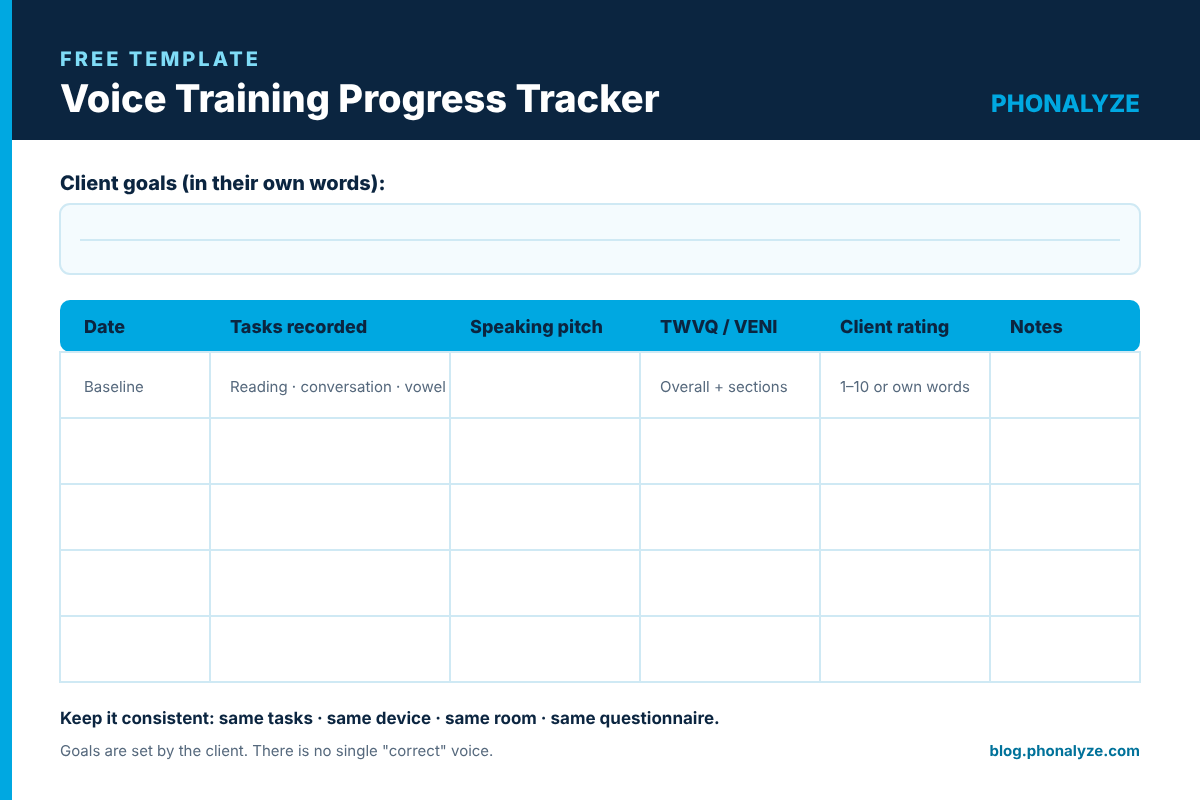
| Baseline | Reading, conversation, sustained vowel | TWVQ or VENI | Client goals in their own words |
| Every few sessions | Same tasks, same set-up | Optional | What’s carrying over into daily life? |
| Plan review | Same tasks; compare with baseline | Repeat the same tool | Update goals together |
| Discharge / follow-up | Same tasks | Repeat the same tool | Maintenance plan |
Remote practice and tracking
Much of gender-affirming voice training happens between sessions. Remote recordings help in three ways: clients can record in real-life settings, clinicians can review practice without extra visits, and clients who live far from a specialist can still get support.
- Same device, same place: ask clients to record on the same phone, in the same quiet room, at a similar distance.
- Same tasks: repeat the same reading passage and conversation prompt so recordings are comparable.
- Privacy first: voice recordings are sensitive health information. Use a secure, HIPAA-compliant platform with a signed BAA, not email or messaging apps.
- Listen together: replay baseline and current recordings side by side during sessions.
For a full remote protocol, see our telepractice voice evaluation guide.
Tracking progress with Phonalyze
Phonalyze is a browser-based voice analysis platform for SLPs. It includes the questionnaires and recording tasks that gender-affirming voice training needs, in one place:
- Built-in questionnaires: the Trans Woman Voice Questionnaire and Voice-Related Experiences of Nonbinary Individuals, plus VHI-10, V-RQOL and others, tracked over time for each client.
- Recording tasks: conversational speech (10 and 15 seconds), sustained vowels and CAPE-V sentences.
- Praat-powered reports in seconds: pitch, intensity, CPP/CPPS, harmonicity, jitter, shimmer and more.
- Remote by link: clients receive an anonymous SMS link and record on their own phone, with no app to install.
- Private and secure: HIPAA-compliant hosting, encrypted data and a signed BAA. See our HIPAA buyer’s guide.
What to document
- The client’s goals, in their own words, and any updates.
- Questionnaire used, date and scores (overall and by section or factor).
- Recording tasks, set-up (device, room, distance) and key measures.
- Carry-over into daily life, and any vocal strain or fatigue reported.
Make progress easy to see
TWVQ, VENI and voice recordings in one secure timeline, with Praat-powered reports in seconds.
Start free trial — no credit card Try the demo30 days free, then $39/month. Cancel anytime.
Frequently asked questions about gender-affirming voice training
Related reading
Sources
- American Speech-Language-Hearing Association. Gender affirming voice and communication (Practice Portal). asha.org
- Coleman E, Radix AE, Bouman WP, et al. Standards of Care for the Health of Transgender and Gender Diverse People, Version 8. Int J Transgend Health. 2022;23(Suppl 1):S1–S259. PMC9553112
- Dacakis G, Davies S, Oates J, Douglas J, Johnston J. Development and preliminary evaluation of the Transsexual Voice Questionnaire for Male-to-Female Transsexuals. J Voice. 2013;27(3):312–320.
- Davies SM, Johnston JR. Exploring the validity of the Transsexual Voice Questionnaire for Male-to-Female Transsexuals. Can J Speech-Lang Pathol Audiol. 2015;39(1):40–49. cjslpa.ca
- Shefcik G, Tsai P-T. Voice-related Experiences of Nonbinary Individuals (VENI): development and content validity. J Voice. doi:10.1016/j.jvoice.2020.12.037. SJSU ScholarWorks
- dos Santos I, Behlau M, Shefcik G, Tsai P-T, Ribeiro VV. Cross-cultural adaptation of the VENI to Brazilian Portuguese. 2024. PMC11166032
This article is educational information for licensed clinicians. Voice goals belong to the client, and no single voice is “correct.” Questions? support@phonalyze.com.
— Phonalyze Team