
Maximum phonation time norms and the s/z ratio are two of the quickest voice measures an SLP can collect. Both need nothing more than a sustained sound and a timer, which makes them ideal for telepractice. This guide brings together published maximum phonation time norms for adults and children, s/z ratio reference values, standard instructions, and a step-by-step method for measuring both remotely.
Key takeaways
- MPT is the longest time a person can sustain a vowel, usually “ah”, on one breath.
- Published adult MPT values vary widely, roughly 15 to 35 seconds, because methods differ between studies.
- Children’s MPT rises with age, from about 6 seconds (ages 4–6) to about 9 seconds (ages 10–12) in a cohort of 1,660 children.
- The s/z ratio compares how long a person can hold /s/ and /z/. Reference values sit close to 1.0.
- Method matters most: clear instructions, a demonstration and several trials give more reliable results, in clinic or at home.
What is maximum phonation time (MPT)?
Maximum phonation time (MPT) is the longest time, in seconds, that a person can sustain a vowel, usually “ah” (/a/), on a single breath at a comfortable pitch and loudness. It reflects how efficiently the breath and the vocal folds work together.
Clinicians use MPT as part of a wider voice evaluation, alongside perceptual ratings, acoustic measures and patient questionnaires. On its own, it does not identify a cause. However, it is fast, free and easy to repeat, so it works well for tracking change over time.
Maximum phonation time norms for adults
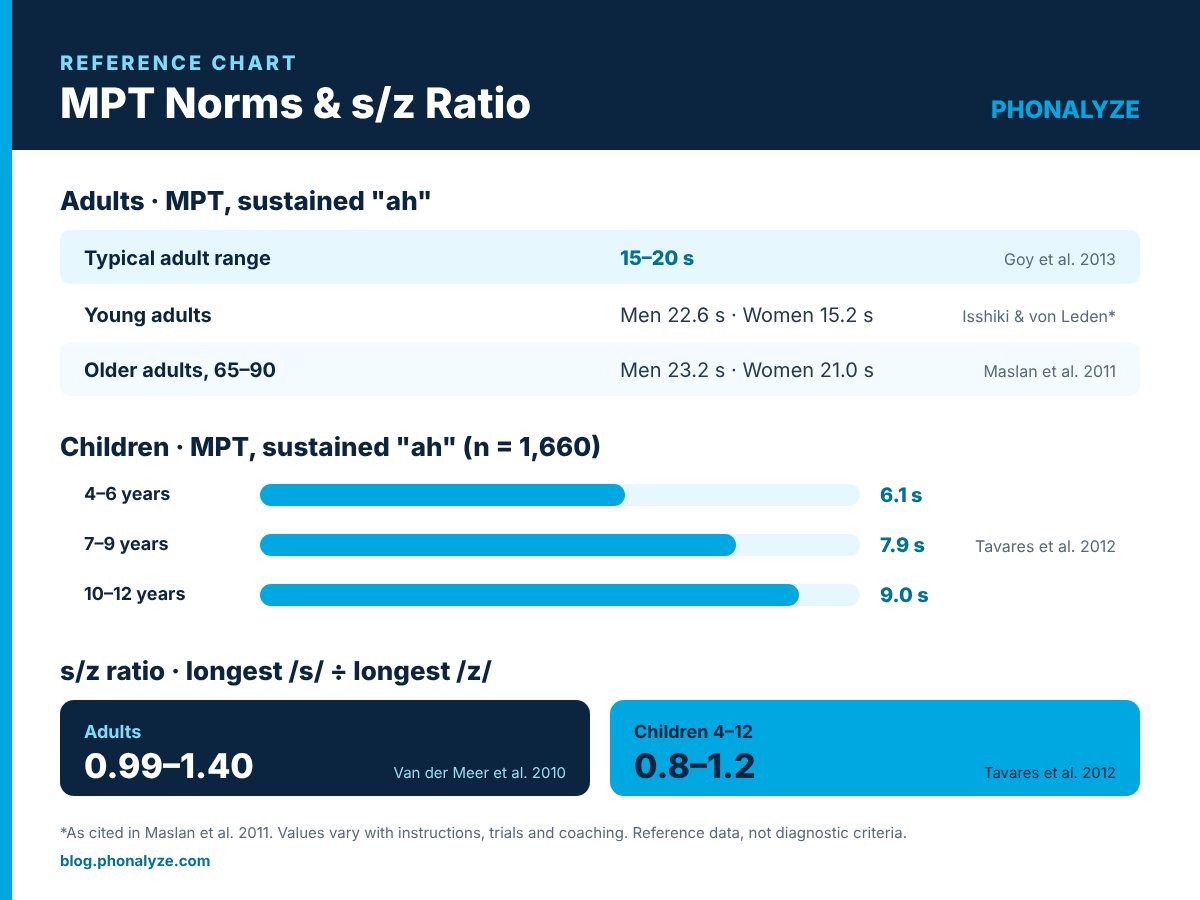
Published maximum phonation time norms for adults differ from study to study. The table below shows why: each study used different instructions, numbers of trials and age groups.
| Source | Group | Men | Women |
|---|---|---|---|
| Goy et al. (2013), summarized by the Sydney Voice Lab | Adults | Typically 15–20 s | |
| Isshiki & von Leden (as cited) | Young adults | 22.6 s (SD 8.1) | 15.2 s (SD 5.0) |
| Ptacek & Sander (as cited) | Adults, pitch and loudness controlled | 17.7–25.7 s | 11.5–24.1 s |
| Hirano et al. (as cited) | All ages, no pitch or loudness control | 34.6 s | 25.7 s |
| Maslan et al. (2011) | Healthy older adults, 65–90 (n = 69) | 23.23 s | 20.96 s |
Two points stand out. First, the spread is large, so a single “normal” cut-off is hard to defend. Second, in Maslan et al. (2011), MPT did not differ significantly by age or sex in healthy adults aged 65 to 90. For these reasons, many clinicians compare a patient with their own baseline, using the same method each time.
Maximum phonation time norms for children
For children, the largest dataset is Tavares et al. (2012). The study measured 1,660 children aged 4 to 12 with no voice signs or symptoms. MPT for sustained /a/ increased with age:
| Age | All | Boys | Girls |
|---|---|---|---|
| 4–6 years | 6.09 s | 5.97 s | 6.21 s |
| 7–9 years | 7.94 s | 8.07 s | 7.79 s |
| 10–12 years | 8.98 s | 9.05 s | 8.92 s |
Children often need more coaching and practice trials. A short demonstration and a game-like prompt, such as “Let’s see how long you can sing ‘ah’ like a siren that never stops,” can help. For more on working with young patients, read Phonalyze in pediatric voice therapy.
What is the s/z ratio?
The s/z ratio compares how long a person can sustain the voiceless sound /s/ with how long they can sustain the voiced sound /z/. You divide the longest /s/ by the longest /z/. Because /s/ uses no voice and /z/ does, the ratio helps separate breath support from vocal fold function.
s/z ratio reference values
| Group | Reference value | Source |
|---|---|---|
| Adults | Typically 0.99–1.40 | Van der Meer et al. (2010), summarized by the Sydney Voice Lab |
| Children 4–12 | Typically 0.8–1.2, near 1.0 for most | Tavares et al. (2012) |
The best-known s/z study is Eckel and Boone (1981). In their sample, speakers with vocal fold nodules or polyps had s/z ratios above 1.4 in 95% of cases. In contrast, speakers with functional voice problems had ratios of about 1.0, the same as the control group. Later research has reported wide individual variation, so the s/z ratio is best treated as one screening clue among many, not as a stand-alone answer.
Use with care: MPT and the s/z ratio are quick screening measures. Reference values come from specific study groups and methods, and they do not diagnose a condition. Always interpret them alongside a full voice evaluation and, where indicated, laryngeal imaging.
Why MPT and s/z results vary
Most differences between studies come from how the task is run. The main factors are:
- Number of trials. Speyer et al. (2010) found reliability of 0.939 for one trial, rising to 0.987 with five trials.
- Instructions and demonstration. Maslan et al. (2011) reported that three trials were enough when patients received clear instructions and a demonstration.
- Coaching and effort. Encouraging the patient to keep going can lengthen the result.
- Posture and breath. Sitting or standing upright and taking a full breath first both matter.
- Pitch and loudness. Studies that controlled these reported different values from studies that did not.
- Longest versus average. Some clinicians record the longest trial; others report the mean. Note which one you use.
In short, consistency matters more than any single number. Use the same script, posture, number of trials and scoring rule at every visit.
Send the MPT task to patients by link and keep every trial on file.
Try Phonalyze freeHow to measure maximum phonation time remotely
MPT is mostly about timing, so it adapts well to telepractice. Follow the steps below, then use the same method every time.
Sample instructions (script)
Clinician: “Sit up tall. Take the biggest breath you can, then say ‘ah’ at a comfortable, normal voice for as long as you possibly can. Keep going until you run out of air. I’ll show you first.”
How to measure the s/z ratio remotely
The s/z ratio uses the same set-up as MPT. Only the sounds change.
- Demonstrate both sounds. Model a steady, comfortable /s/ (like a snake) and /z/ (like a bee).
- Record at least two trials of each. Alternate /s/ and /z/, with rest in between.
- Keep loudness comfortable. Ask for a steady sound, not a forced one.
- Calculate the ratio. Divide the longest /s/ by the longest /z/.
- Watch the audio. Video-call software can suppress steady hissing sounds as “noise”, so time the sounds from a direct recording or from the patient’s visible mouth movement, not from call audio alone.
Measuring MPT with Phonalyze
Phonalyze is a browser-based voice analysis platform for SLPs. It includes a built-in MPT “aaah” task, alongside sustained vowels, CAPE-V sentences and conversational speech.
- Remote by link: patients receive an anonymous SMS link and record on their own phone, with no app to install.
- Live sessions: record in clinic and get results by email and in Phonalyze in seconds.
- Praat analysis: recordings are analyzed with Praat, so you can review CPP/CPPS, AVQI, harmonicity, jitter, shimmer, pitch, voicing and intensity in the same report.
- Every trial on file: compare recordings across visits instead of relying on notes.
- HIPAA-compliant: encrypted data, HIPAA-compliant hosting and a signed BAA. See our HIPAA buyer’s guide.
For a full remote protocol, including CAPE-V and documentation, read the telepractice voice evaluation guide.
What to document
- Task (sustained /a/, /s/, /z/), number of trials and each time in seconds.
- Scoring rule (longest or mean) and the resulting MPT and s/z ratio.
- Posture, instructions, demonstration and any coaching given.
- Setting: in clinic or remote, device used, and any problems (noise, coughing, connection drops).
Run MPT remotely, the same way every time
Send the MPT task by link, keep every trial and get a Praat-powered voice report in seconds.
Start free trial — no credit card Try the demo30 days free, then $39/month. Cancel anytime.
Frequently asked questions about MPT and the s/z ratio
Related reading
Sources
- Maslan J, Leng X, Rees C, Blalock D, Butler SG. Maximum phonation time in healthy older adults. J Voice. 2011;25(6):709–713. PMC3128209
- Speyer R, Bogaardt HCA, Passos VL, et al. Maximum phonation time: variability and reliability. J Voice. 2010;24(3):281–284. PMID 19111437
- Tavares ELM, Brasolotto AG, Rodrigues SA, Pessin ABB, Martins RHG. Maximum phonation time and s/z ratio in a large child cohort. J Voice. 2012;26(5):675.e1–4. doi:10.1016/j.jvoice.2012.03.001
- Eckel FC, Boone DR. The s/z ratio as an indicator of laryngeal pathology. J Speech Hear Disord. 1981;46(2):147–149. doi:10.1044/jshd.4602.147
- Goy H, Fernandes DN, Pichora-Fuller MK, van Lieshout P. Normative voice data for younger and older adults. J Voice. 2013;27(5):545–555.
- Van der Meer G, Ferreira Y, Loock JW. J Crit Care. 2010;25(3):489–492.
- Sydney Voice Lab. Acoustic analysis normative data reference sheet (v4.0, 2025). sydney.edu.au
This article is educational information for licensed clinicians. Reference values come from published studies and are not diagnostic criteria. Questions? support@phonalyze.com.
— Phonalyze Team